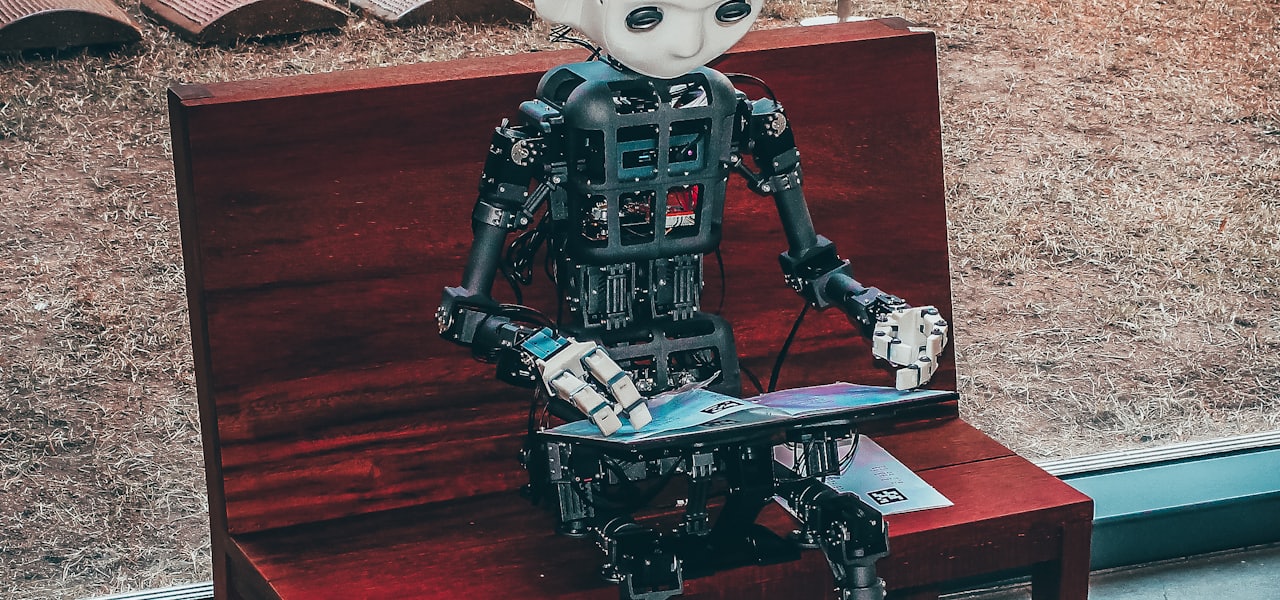
AlphaTensor is an artificial intelligence system developed by DeepMind for discovering efficient matrix multiplication algorithms using reinforcement learning. Introduced in 2022, the system was based on AlphaZero and formulated the search for matrix multiplication algorithms as a single-player game called TensorGame. AlphaTensor was designed to search for new ways to multiply matrices with fewer scalar multiplication operations. Matrix multiplication is a fundamental operation in linear algebra, numerical analysis, scientific computing, computer graphics, and machine learning. The system discovered thousands of matrix multiplication algorithms, including algorithms that rediscovered known human-designed methods and others that improved on previously known results for particular matrix sizes and mathematical settings. == Background == Matrix multiplication is one of the basic operations in numerical computing. The standard algorithm for multiplying two square matrices has cubic time complexity, while faster algorithms such as the Strassen algorithm reduce the number of multiplication operations by using more complex algebraic decompositions. Finding optimal matrix multiplication algorithms can be difficult because it involves searching through a large space of possible tensor decompositions. AlphaTensor approached this problem by representing algorithm discovery as TensorGame, in which each move corresponds to an operation that reduces a tensor representing matrix multiplication. The goal of the game is to find a low-rank decomposition of the matrix multiplication tensor, corresponding to an efficient multiplication algorithm. == Development == AlphaTensor was developed by DeepMind and described in a paper published in Nature in October 2022. The system built on the reinforcement-learning approach used in AlphaZero, which had previously been applied to games such as Go, chess, and shogi. Unlike those games, TensorGame involved a very large search space, requiring changes to the AlphaZero-style search method and neural network architecture. DeepMind released source code and discovered algorithms associated with the publication through a public GitHub repository. == Results == AlphaTensor discovered matrix multiplication algorithms over both standard arithmetic and finite fields. One widely reported result was a method for multiplying 4 × 4 matrices over the field with two elements using 47 multiplication operations, improving on the 49 operations required by applying Strassen's algorithm recursively in that setting. The system also found algorithms optimized for particular computer hardware, including algorithms designed for graphics processing units and Tensor Processing Units. DeepMind stated that some of the hardware-specific algorithms improved practical execution time compared with commonly used algorithms on the tested hardware. == Significance == AlphaTensor was described as an example of using machine learning not only to apply existing algorithms, but to assist in discovering new ones. The work was connected to broader research in algorithm discovery, automated machine learning, program synthesis, and computational complexity theory, especially the open problem of determining the optimal complexity of matrix multiplication. AlphaTensor later became part of a broader group of Google DeepMind systems for algorithm and mathematical discovery, alongside systems such as AlphaDev and AlphaEvolve.
Circle Hough Transform
The circle Hough Transform (CHT) is a basic feature extraction technique used in digital image processing for detecting circles in imperfect images. The circle candidates are produced by “voting” in the Hough parameter space and then selecting local maxima in an accumulator matrix. It is a specialization of the Hough transform. == Theory == In a two-dimensional space, a circle can be described by: ( x − a ) 2 + ( y − b ) 2 = r 2 ( 1 ) {\displaystyle \left(x-a\right)^{2}+\left(y-b\right)^{2}=r^{2}\ \ \ \ \ (1)} where (a,b) is the center of the circle, and r is the radius. If a 2D point (x,y) is fixed, then the parameters can be found according to (1). The parameter space would be three dimensional, (a, b, r). And all the parameters that satisfy (x, y) would lie on the surface of an inverted right-angled cone whose apex is at (x, y, 0). In the 3D space, the circle parameters can be identified by the intersection of many conic surfaces that are defined by points on the 2D circle. This process can be divided into two stages. The first stage is fixing radius then find the optimal center of circles in a 2D parameter space. The second stage is to find the optimal radius in a one dimensional parameter space. === Find parameters with known radius R === If the radius is fixed, then the parameter space would be reduced to 2D (the position of the circle center). For each point (x, y) on the original circle, it can define a circle centered at (x, y) with radius R according to (1). The intersection point of all such circles in the parameter space would be corresponding to the center point of the original circle. Consider 4 points on a circle in the original image (left). The circle Hough transform is shown in the right. Note that the radius is assumed to be known. For each (x,y) of the four points (white points) in the original image, it can define a circle in the Hough parameter space centered at (x, y) with radius r. An accumulator matrix is used for tracking the intersection point. In the parameter space, the voting number of those points that have a newly defined circle passing through them would be increased by one for every circle. Then the local maxima point (the red point in the center in the right figure) can be found. The position (a, b) of the maxima would be the center of the original circle. === Multiple circles with known radius R === Multiple circles with same radius can be found with the same technique. Note that, in the accumulator matrix (right fig), there would be at least 3 local maxima points. === Accumulator matrix and voting === In practice, an accumulator matrix is introduced to find the intersection point in the parameter space. First, we need to divide the parameter space into “buckets” using a grid and produce an accumulator matrix according to the grid. The element in the accumulator matrix denotes the number of “circles” in the parameter space that are passing through the corresponding grid cell in the parameter space. The number is also called “voting number”. Initially, every element in the matrix is zeros. Then for each “edge” point in the original space, we can formulate a circle in the parameter space and increase the voting number of the grid cell which the circle passes through. This process is called “voting”. After voting, we can find local maxima in the accumulator matrix. The positions of the local maxima are corresponding to the circle centers in the original space. === Find circle parameter with unknown radius === Since the parameter space is 3D, the accumulator matrix would be 3D, too. We can iterate through possible radii; for each radius, we use the previous technique. Finally, find the local maxima in the 3D accumulator matrix. Accumulator array should be A[x,y,r] in the 3D space. Voting should be for each pixels, radius and theta A[x,y,r] += 1 The algorithm : For each A[a,b,r] = 0; Process the filtering algorithm on image Gaussian Blurring, convert the image to grayscale ( grayScaling), make Canny operator, The Canny operator gives the edges on image. Vote on all possible circles in accumulator. The local maximum voted circles of Accumulator A gives the circle Hough space. The maximum voted circle of Accumulator gives the circle. The Incrementing for Best Candidate : For each A[a,b,r] = 0; // fill with zeroes initially, instantiate 3D matrix For each cell(x,y) For each theta t = 0 to 360 // the possible theta 0 to 360 b = y – r sin(t PI / 180); //polar coordinate for center (convert to radians) a = x – r cos(t PI / 180); //polar coordinate for center (convert to radians) A[a,b,r] +=1; //voting end end == Examples == === Find circles in a shoe-print === The original picture (right) is first turned into a binary image (left) using a threshold and Gaussian filter. Then edges (mid) are found from it using canny edge detection. After this, all the edge points are used by the Circle Hough Transform to find underlying circle structure. == Limitations == Since the parameter space of the CHT is three dimensional, it may require lots of storage and computation. Choosing a bigger grid size can ameliorate this problem. However, choosing an appropriate grid size is difficult. Since too coarse a grid can lead to large values of the vote being obtained falsely because many quite different structures correspond to a single bucket. Too fine a grid can lead to structures not being found because votes resulting from tokens that are not exactly aligned end up in different buckets, and no bucket has a large vote. Also, the CHT is not very robust to noise. == Extensions == === Adaptive Hough Transform === J. Illingworth and J. Kittler introduced this method for implementing Hough Transform efficiently. The AHT uses a small accumulator array and the idea of a flexible iterative "coarse to fine" accumulation and search strategy to identify significant peaks in the Hough parameter spaces. This method is substantially superior to the standard Hough Transform implementation in both storage and computational requirements. == Application == === People Counting === Since the head would be similar to a circle in an image, CHT can be used for detecting heads in a picture, so as to count the number of persons in the image. === Brain Aneurysm Detection === Modified Hough Circle Transform (MHCT) is used on the image extracted from Digital Subtraction Angiogram (DSA) to detect and classify aneurysms type. == Implementation code == Circle Detection via Standard Hough Transform, by Amin Sarafraz, Mathworks (File Exchange) Hough Circle Transform, OpenCV-Python Tutorials (archived version on archive.org)
17LIVE
17LIVE is an international entertainment platform. As of 2024, 17LIVE is the #3 live broadcasting platform globally, formed by its flagship live stream app 17LIVE (LIVIT in English markets), MEME Live and live stream e-commerce platforms HandsUP and OrderPally. == History == 17LIVE was first founded in Taiwan in 2015 by Jeffery Huang. The company has maintained its leading position since its entry into the Japan market in 2017, becoming the biggest platform for live entertainment in Japan, Taiwan, Hong Kong, and other countries. In 2017, 17 closed out US$33M in series B round to merge with dating software Paktor, with Joseph Phua (Co-founder of Paktor) taking over the leadership of 17LIVE as CEO and Co-founder, as well as to enter the Japan and Hong Kong market. Within one year, 17 Media became the #1 market leader in Japan. In 2018, the company raised $25M in series C round as it got ready for US IPO, which failed to materialize. 17LIVE had an unsuccessful US IPO attempt in 2018. Since then, the company reformed and transformed the business. Some key initiatives include the hiring of current CEO Hirofumi Ono, spin-off of Paktor (dating software business unit), full buy-out of founder Jeffery Huang, acquisition of MEME and HandsUp, and more. Despite the failed IPO attempt, the company continued to push for international expansion, including creating ‘LIVIT’ for the English-speaking markets to enter US, India, and North Africa. In 2019, 17's flagship live streaming app reached 10M downloads in Japan, and the business continues to push for both organic and inorganic expansion. Some key M&A highlights in the year include the acquisition of MEME Live in Southeast Asia, as well as HandsUp, a live e-commerce platform. In 2020, M17 closed out $26.5M in Series D round to continue organic growth in Japan, US and Middle East. In the same year, the company also sold its dating app business, Parktor, to rationalise M17 into a live-stream pure play business, followed by the appointment of its current Chairman, Joseph Phua, and previous Global CEO, Hirofumi Ono. With the buy-out and departure of founder Jeff Huang, the parent holding company M17 Entertainment Limited was officially renamed as 17 LIVE Group. An estimated 60 million users registered in 154 countries and territories in April 2022. In 2022, September, 17LIVE announced Group CEO Hirofumi Ono steps down. Alex Lien takes over the leadership as new Group COO; Jing Shen Ng appointed Group CTO. In 2023, March, 17LIVE announced Alex Lien promoted to Global CEO. Kenta Masuda appointed as Global CFO. === Collaboration with Ayumi Hamasaki === To celebrate its 4th anniversary, 17LIVE collaborated with Japanese singer-songwriter Ayumi Hamasaki, who led the 17LIVE 4th Anniversary meets Ayumi Hamasaki series starting October 18, 2021. Along with composer and arranger Yuta Nakano, Hamasaki judged auditioning artists competing for the chance to work with her and her production team for a debut single. The series was streamed live on the 17LIVE website, the final airing on November 11. The eventual winner was named as Yoshitaka_song. When asked why she collaborated with 17LIVE as a producer, Hamasaki commented: "Although the world has become like this (during COVID-19), I believe that the art of entertainment can give people dreams, hope, courage, and strength. I hope that kind of light will continue to shine through the entertainment industry." == Features == On 17LIVE, artists (LIVERs) are able to broadcast live, and post photos and videos from their album. The app has been designed for LIVERs to simply open the App, and start sharing contents without the need to edit or professionally curate their videos. The platform cultivates LIVERs, supports them with a local content management team, and provides artists with various functions, such as real time chatting, gifting, fan clubs, interactive competition and events. Today, 17LIVE has 46 thousands contracted artists and more than 2.3 million MAU, who spend 44 minutes on the platform every day. 17LIVE continues to advocate content-driven philosophy and delivers diverse topics, from politics and music to entertainment, to broaden its audience groups. 17LIVE also hosts offline flash events and concerts to attract new users and support LIVERs better connect with their fans. == Operation == 17LIVE has over 700 employees globally. The app provides few monetization models for LIVERs on the platform, including: Gifting: user / fans buy virtual gifts on the app to send to their favored LIVERs. Subscription: monthly subscription fan club service for access to exclusive content Pay-per-view: ticket service for online streaming concerts E-commerce: live e-commerce platform In the past, 17LIVE has encountered some regulatory headwinds with reported incidents of inappropriate livestream content on the platform. The incidents were direct results of the lack of oversight and supervision capability in place in the business at the time. Over the years, 17LIVE claims to have put in tremendous manpower and effort into improving, monitoring and maintaining control over both the live stream content and the KYC procedures and systems.
BabyCenter
BabyCenter is an online media company based in San Francisco, New York City, Chicago, and Los Angeles that provides information on conception, pregnancy, birth, and early childhood development for parents and expecting parents. BabyCenter operates 8 country and region specific properties including websites, apps, emails, print publications, and an online community where parents can connect on a variety of topics. The visitors of website and the users of the app can sign up for free weekly email newsletters that guide them through pregnancy and their child's development. In addition to publishing detailed, medically reviewed information about pregnancy and parenting, BabyCenter, under its Mission Motherhood initiative, ran numerous social programs and has participated in public health initiatives in partnership with hospitals, healthcare agencies, nonprofits, NGOs, and government agencies to provide pregnancy and parenting advice. It also annually publishes the most popular baby names. BabyCenter LLC is part of the Everyday Health Group, a division of Ziff Davis. == History == BabyCenter was founded in October 1997 by Stanford University MBA graduates Matt Glickman and Mark Selcow, who recognized a need for information about pregnancy and parenting on the internet. BabyCenter was initially funded through $13.5 million in startup capital funding from venture capital firms, including Bessemer Venture Partners, Intel, and Trinity Ventures. The funds were used to open the BabyCenter Store in October 1998. In the early years of its operation, BabyCenter offered multiple resources and services for parents, including a website that provided medically reviewed information and guidance to new and expectant parents on such topics as fertility, labor, and childcare; a weekly email for pregnant women tailored to their week of pregnancy (based on their pregnancy due date); and community groups and chat rooms for pregnant couples and parents to discuss pregnancy and child-rearing strategies. The site grew quickly, and by early 1999 had 175 employees and an annual revenue of $35 million. In April of that year, the two founders sold BabyCenter to another website, eToys.com, for $190 million in stock. Twenty-three months later, in 2001, shortly before declaring bankruptcy, eToys sold the site to Johnson & Johnson for $10 million. During the eToys ownership, BabyCenter launched its first international E-commerce site in the UK during the spring of 2000. Starting in 2005, BabyCenter launched an expansion plan, extending its global network to Australia, Canada and other countries, staffing each outpost with local editors. In 2007, BabyCenter debuted a Mandarin-language site in China, initiated operations in India, launched a Spanish language website, and introduced its first mobile site. BabyCenter released My Pregnancy Today, its first mobile app, to Apple's App Store in August 2010 and to the Android market in April 2011. The app provided daily information, nutrition tips, advice relevant to the user's week of pregnancy, and 3-D animated videos showcasing a baby's development in utero. The My Pregnancy app was joined by a My Baby Today app in October 2011. In 2015, BabyCenter released Mom Feed, its first mobile app for parents of toddlers and older children (ages 1 to 8). Mom Feed offered personalized, stage-based information as well as content from the BabyCenter Community and Blog in a real-time stream. In 2016, BabyCenter launched its web-based Baby Names Finder. In 2018, Mom Feed was discontinued and BabyCenter replaced that experience with a separate Child Health content area on its website. Also in 2018, BabyCenter launched its mobile baby name generator, the Baby Names app, which, like the web-based Baby Names Finder, leverages data from hundreds of thousands of parents that culminates in its annual most popular Baby Names Report. In 2019, Johnson & Johnson sold Baby Center to Everyday Health Group, a division of New York-based parent company of Ziff Davis, Inc. Neither side disclosed terms of the deal. == Popular research == BabyCenter's most popular baby names is released annually and often cited by the media. In March 2024, BabyCenter did a review of the app Temu and said that the website has found products that have been recalled, could be counterfeit or circumvent U.S. safety standards and features that are important in preventing issues like choking. In 2025, BabyCenter released a report about the cost of raising a newborn baby in the first year. == Content and products == === Websites === BabyCenter has 8 country and region-specific websites around the world, including sites for the United States, Canada, Australia, Brazil, India, Germany, the United Kingdom, and Latin America. Users can find parenting and pregnancy advice in seven languages: English, Spanish, Portuguese, Arabic, French, German, and Hindi BabyCenter content for each country- or region-specific site is written by an editorial team based in that country or region. Medical and health content for each site is reviewed by a medical advisory board based there and adheres to that country or region's medical standards. For example, the U.S. site works with and follows the recommendations of such U.S. medical authorities as the American Academy of Pediatrics, the American Congress of Obstetrics & Gynecology and the Society for Maternal-Fetal Medicine. BabyCenter regularly conducts research and provides thought leadership on pregnancy and parenting topics, popularly cited by major media outlets including The Wall Street Journal, Forbes, The Washington Post, BuzzFeed, Insider, MarketWatch, Axios. === Community, blogs and social === From its earliest days, BabyCenter has had a community area that allows people to join a group of parents with children born in the same month, known as a Birth Club. BabyCenter launched a blog called Momformation in 2007. Eventually, the name was changed to BabyCenter Blog. In April 2021, the BabyCenter Community was identified in a research article within the journal PLOS Computational Biology as facilitating "unobstructed communication" between parents, which avoids the "strong echo chamber phenomena" that can foster and perpetuate vaccine misinformation. === My Pregnancy and Baby Today App === The app is available in six languages, although not all features are supported for every market. Initially the apps only featured pregnancy articles that could be found on the BabyCenter website, but over the years the feature set has expanded to include a growing list of app-specific tools such as weekly fetal development information, a kick tracker, a birth plan worksheet, a contraction timer, a baby growth tracker, a photo journal for pregnant women to record their pregnancy bellies, and a photo journal for documenting a baby's first year. === Mission Motherhood™ === BabyCenter was a cofounder of the Mobile Alliance for Maternal Action (MAMA), a public-private partnership between USAID, Johnson & Johnson, the UN Foundation, and BabyCenter from 2011 to-to 2015. The MAMA program sparked the creation of MomConnect, an initiative of the South African Department of Health for which BabyCenter developed SMS messages with health information about pregnancy and a child's first year of life. BabyCenter helped develop similar messages for mMitra, a voice messaging program in India. A research article in the Maternal and Child Health Journal stated the mMitra program offered strong evidence "that tailored mobile phone voice messages can improve key infant care knowledge and practices that lead to improved infant health outcomes in low-resource settings. BabyCenter's Mission Motherhood Messages were available to qualifying organizations on the BabyCenter website. BabyCenter contributed websites for Free Basics. These websites featured age and stage-based pregnancy and baby articles targeted to low-income, lower-education women who would not otherwise have access to health information. Content developed for this program was also used to support a UNICEF SMS program during the 2016 Zika outbreak. == Awards and recognition == In 1998, BabyCenter won a Webby Award for Best Home Site. Since then, it has been nominated for a Webby Award 19 times and won either a Webby or a People's Choice Webby Award 12 times – including a People's Voice win in 2021 for Lifestyle websites and mobile sites. In 2002, it won Service Journalism award from Online Journalism Awards (OJA). In 2015, BabyCenter won five Digital Health Awards for content about autism in children. In 2016, BabyCenter won seven Digital Health Awards: four for videos about the aches and pains of pregnancy, baby sleep, and the walking milestone in child development; two for articles about baby sleep training and sleep apnea in babies; and one for the BabyCenter mobile app My Pregnancy & Baby Today. In 2021, Forbes Health chose My Pregnancy & Baby Today as the best pregnancy app of 2021, and Women's Health identified it
Drops (app)
Drops is a language learning app that was created in Estonia by Daniel Farkas and Mark Szulyovszky in 2015. It is the second product from the company, after their first app, LearnInvisible, had issues in retaining a user's engagement over the required time period. The languages available include Native Hawaiian and Māori, and was classified as one of the fifty "Most Innovative Companies" for 2019 by Fast Company. The company partnered with Global Eagle Entertainment to include Travel Talk, a feature intended to focus on words and phrases frequently used by travelers. At the beginning of the COVID-19 pandemic in March 2020, the number of users increased by 55 percent in the United States and 92 percent in the United Kingdom. Droplets, a language app for children, includes profiles for multiple teachers working with remote students. The company also produces an app called Scripts, intended to help users learn to write alphabets. The app was purchased by the Norwegian company Kahoot! on 24 November 2020.
DABUS
DABUS (Device for the Autonomous Bootstrapping of Unified Sentience) is an artificial intelligence (AI) system created by Stephen Thaler. It reportedly conceived of two novel products — a food container constructed using fractal geometry, which enables rapid reheating, and a flashing beacon for attracting attention in an emergency. The filing of patent applications designating DABUS as inventor has led to decisions by patent offices and courts on whether a patent can be granted for an invention reportedly made by an AI system. == History in different jurisdictions == === Australia === On 17 September 2019, Thaler filed an application to patent a "Food container and devices and methods for attracting enhanced attention," naming DABUS as the inventor. On 21 September 2020, IP Australia found that section 15(1) of the Patents Act 1990 (Cth) is inconsistent with an artificial intelligence machine being treated as an inventor, and Thaler's application had lapsed. Thaler sought judicial review, and on 30 July 2021, the Federal Court set aside IP Australia's decision and ordered IP Australia to reconsider the application. On 13 April 2022, the Full Court of the Federal Court set aside that decision, holding that only a natural person can be an inventor for the purposes of the Patents Act 1990 (Cth) and the Patents Regulations 1991 (Cth), and that such an inventor must be identified for any person to be entitled to a grant of a patent. On 11 November 2022, Thaler was refused special leave to appeal to the High Court. === European Patent Office === On 17 October 2018 and 7 November 2018, Thaler filed two European patent applications with the European Patent Office. The first claimed invention was a "Food Container" and the second was "Devices and Methods for Attracting Enhanced Attention." On 27 January 2020, the EPO rejected the applications on the grounds that the application listed an AI system named DABUS, and not a human, as the inventor, based on Article 81 and Rule 19(1) of the European Patent Convention (EPC). On 21 December 2021, the Board of Appeal of the EPO dismissed Thaler's appeal from the EPO's primary decision. The Board of Appeal confirmed that "under the EPC the designated inventor has to be a person with legal capacity. This is not merely an assumption on which the EPC was drafted. It is the ordinary meaning of the term inventor." === United Kingdom === Similar applications were filed by Thaler to the United Kingdom Intellectual Property Office on 17 October and 7 November 2018. The Office asked Thaler to file statements of inventorship and of right of grant to a patent (Patent Form 7) in respect of each invention within 16 months of the filing date. Thaler filed those forms naming DABUS as the inventor and explaining in some detail why he believed that machines should be regarded as inventors in the circumstances. His application was rejected on the grounds that: (1) naming a machine as inventor did not meet the requirements of the Patents Act 1977; and (2) the IPO was not satisfied as to the manner in which Thaler had acquired rights that would otherwise vest in the inventor. Thaler was not satisfied with the decision and asked for a hearing before an official known as the "hearing officer". By a decision dated 4 December 2019 the hearing officer rejected Thaler's appeal. Thaler appealed against the hearing officer's decision to the Patents Court (a specialist court within the Chancery Division of the High Court of England and Wales that determines patent disputes). On 21 September 2020, Mr Justice Marcus Smith upheld the decision of the hearing officer. On 21 September 2021, Thaler's further appeal to the Court of Appeal was dismissed by Arnold LJ and Laing LJ (Birss LJ dissenting). On 20 December 2023, the UK Supreme Court dismissed a further appeal by Thaler. In its judgment, the court held that an "inventor" under the Patents Act 1977 must be a natural person. === United States === The patent applications on the inventions were refused by the USPTO, which held that only natural persons can be named as inventors in a patent application. Thaler first fought this result by filing a complaint under the Administrative Procedure Act alleging that the decision was "arbitrary, capricious, an abuse of discretion and not in accordance with the law; unsupported by substantial evidence, and in excess of Defendants’ statutory authority." A month later on August 19, 2019, Thaler filed a petition with the USPTO as allowed in 37 C.F.R. § 1.181 stating that DABUS should be the inventor. The judge and Thaler agreed in this case that Thaler himself is unable to receive the patent on behalf of DABUS. In their August 5, 2022, Thaler decision, the US Court of Appeals for the Federal Circuit affirmed that only a natural person could be an inventor, which means that the AI that invents any other type of invention is not addressed by the "who" mentioned in the legislation. === New Zealand === On January 31, 2022, the Intellectual Property Office of New Zealand (IPONZ) decided that a patent application (776029) filed by Stephen Thaler was void, on the basis that no inventor was identified on the patent application. IPONZ determined that DABUS could not be "an actual devisor of the invention" as required by the Patents Act 2013, and that this must be a natural person as held by the previous patent offices above. The High Court of New Zealand confirmed the decision in 2023. === South Africa === On 24 June 2021, the South African Companies and Intellectual Property Commission (CIPC) accepted Dr Thaler's Patent Cooperation Treaty, for a patent in respect of inventions generated by DABUS. In July 2021, the CIPC released a notice of issuance for the patent. It is the first patent granted for an AI invention. === Switzerland === On June 26, 2025, the Swiss Federal Administrative Court ruled that artificial intelligence systems such as DABUS cannot be listed as inventors in patent applications. The court upheld the existing practice of the Swiss Federal Institute of Intellectual Property (IPI), which requires that only natural persons can be recognized as inventors under Swiss patent law. The case concerned a patent application, which sought to designate DABUS as the sole inventor of a food container designed with a fractal geometry to enhance heat distribution. The IPI had rejected the application, arguing that both the absence of a human inventor and the attribution of inventorship to an AI system were inadmissible. While the court dismissed Thaler's main request, it accepted a subsidiary request: if a human applicant recognizes and files a patent based on an AI-generated invention, that person may be considered the inventor. As a result, the application may proceed with Thaler listed as the inventor. The decision (B-2532/2024) can still be appealed to the Swiss Federal Supreme Court.
N-World
N-World is a 3D graphics package developed by Nichimen Graphics in the 1990s, for Silicon Graphics and Windows NT workstations. Intended primarily for video game content creation, it has polygon modeling tools, 2D and 3D paint, scripting, color reduction, and exporters for several popular game consoles. After its initial release on Windows NT, N-World was renamed Mirai. The winged edge 3D modeler in N-World inspired the development at Nichimen Graphics of Nendo, a standalone 3D modeler, which in turn inspired the open source modeler Wings 3D. == History == N-World originated with Symbolics, a computer manufacturer notable for producing Lisp-based systems in the 1980s. Among the software packages that were produced for Symbolics computers are S-Graphics, a 3D animation suite that includes modules for polygon modeling, dynamics, paint, and rendering — titled S-Geometry, S-Dynamics, S-Paint, and S-Render, respectively. In 1992, Japanese trading company Nichimen Corporation purchased the rights to S-Graphics, ported it to Silicon Graphics IRIX, and marketed it as N-World. N-World retains the Lisp-based underpinnings of its predecessor, but was targeted at interactive content producers, with features useful for game developers. It was priced at US$16,995 (equivalent to $34,100 in 2025) for the full suite, later reduced to $9,995 when ported to Windows NT in 1997. N-World was used to create graphics for many console games in the 1990s, specifically most of the Nintendo 64 games, like Super Mario 64 and Final Fantasy VII. It was superseded by Mirai in 1999. == Features == The N-World package, like its predecessor S-Graphics, is divided into several components: N-Geometry: 3D polygon-based modeling tools, including smoothing, "magnet" geometry editing, and instancing. N-Dynamics: Animation tools including scripting, curve-based animation, and skeletal animation. N-Render: Surfacing and rendering tools with ray tracing and materials output to various game console formats. N-Paint: 2D and 3D paint with mattes, effects, color reduction, and a visual VRAM editor for PlayStation. Game Tools: Utilities for game developers, including exporters for PlayStation, Nintendo 64, and Saturn consoles. == Credits == The following games were created using N-World. Rap Stars Online